Slate Roofing in Maryland: Beauty, Longevity, and What to Expect
Most people who own a slate roof never chose one. They bought a house that already had it — a century-old center-hall Colonial, a farmhouse outside Huntingtown, a brick home in one of the older streets of Annapolis — and then a contractor climbed up, came back down, and recommended a full tear-off. That recommendation is wrong more often than it is right.
Slate is the longest-lived roofing material available to a homeowner, and the stone routinely outlasts everything holding it in place. Knowing the difference between a roof that has failed and a roof whose fasteners have failed is worth a great deal of money. G.H. Clark Contractors has inspected roofs across Calvert, Anne Arundel, and St. Mary’s counties for more than 30 years, and slate raises a different set of questions than any other material.
What Is a Slate Roof?
Slate is quarried metamorphic stone, split by hand along its natural cleavage planes into thin flat shingles. It is a geological material rather than a manufactured one, which is why quality varies by quarry instead of by brand, and why the industry grades it under ASTM C406.
Nothing about a slate roof is engineered the way an asphalt shingle is engineered. There is no mat, no adhesive, no granule coating, no sealant strip. There is stone, two nails per piece, and enough overlap that water never reaches the deck. The system has not fundamentally changed in several hundred years because it never needed to. What varies is the rock itself, and mineral composition determines how much water a slate absorbs, how it handles freezing, and whether it will still be up there in a hundred years.
Did Maryland Ever Produce Its Own Roofing Slate?
Yes. The Peach Bottom slate belt runs from southeastern Pennsylvania into Harford County, Maryland, where quarrying began around 1734. The first commercial slate quarry in the United States opened along that ridge, and Peach Bottom slate was judged the finest roofing slate in the world at the 1851 London exhibition.
Welsh farmers found the outcrop while digging a foundation and roofed their own buildings with it, the first recorded use of native roofing slate in America. Commercial quarrying followed around 1785. Once the Susquehanna and Tidewater Canal opened in 1840, Welsh slaters emigrated to work the ridge, and by 1890 roughly three-quarters of all Peach Bottom slate was coming from the Maryland side of the line.
Those quarries are long closed, but the material is still on roofs and in cemeteries across the region. Slate headstones cut before the Civil War remain legible, which tells you most of what you need to know about how the stone ages. The Maryland Historical Trust marked the site in 1967.
How Long Does a Slate Roof Actually Last?
ASTM C406 grades roofing slate S1, S2, or S3. Grade S1 carries an expected service life beyond 75 years, S2 runs 40 to 75 years, and S3 only 20 to 40. Nearly all slate installed new in North America today is S1.
Real performance stretches well past the grade. S1 slate commonly reaches 100 to 200 years, and quarry source drives the spread more than anything else. Some Pennsylvania soft-vein slate falls short of 60 years. Peach Bottom exceeds 200.
The physical property that matters most is water absorption. S1 slate takes on less than a quarter of one percent of its weight in water, which is why Maryland freeze-thaw cycles do so little to it. Porous stone absorbs water, freezes, and delaminates.
What Usually Fails First on a Slate Roof?
The flashing and the fasteners, not the stone. Copper nails last well over a century while galvanized fasteners give out in 40 to 75 years. A roof shedding slates is frequently a roof whose nails have corroded, and that calls for repair rather than replacement.
This is the single most useful thing an owner of an older slate roof can know. Slates sliding off in ones and twos, particularly along one slope or around one chimney, point to fastener or flashing failure. Slates that are flaking, crumbling at the nail holes, and sounding dull when tapped point to the stone itself giving out. Those two conditions call for completely different work and completely different money.
Two failure signatures worth telling apart:
- Fastener failure: slates intact on the ground, gaps clustered on one slope or beside a chimney
- Flashing failure: leaks tracking to valleys, walls, and penetrations rather than open field
- Stone failure: flaking surfaces, delamination, and slates crumbling at the nail holes
- End of service life: dull sound under a tap across the whole roof, not just one area
Code reflects the same reality. Section R905.6.6 requires flashing and counterflashing in sheet metal, with valley flashing at least 15 inches wide at a minimum uncoated thickness of G90 zinc-coated steel. Anything lighter will fail long before the slate does.
Can Your Home Support the Weight of Slate?
Slate weighs 800 to 1,500 pounds per square, against roughly 250 to 400 for architectural asphalt. Standard three-sixteenths-inch slate runs 7 to 8 pounds per square foot installed, and heavy graduated slate can exceed 15. Most modern residential framing needs reinforcement to carry it.
A house built for slate was framed for slate. Rafters are heavier, spacing is tighter, and the structure has already carried that load for a century without complaint. A house built outside Dunkirk in 1995 for asphalt shingles was not framed that way, and no amount of enthusiasm for the look changes the arithmetic. A structural evaluation comes before the material decision, not after it.
- Existing framing size, species, and spacing
- Span between bearing walls and the condition of the sheathing
- Whether a previous roof was ever removed or simply covered over
- Snow load and wind uplift requirements for the site
- Structural modifications made during past renovations
What Does Maryland Building Code Require for Slate Roofs?
Maryland follows the 2021 International Residential Code. Section R905.6 limits slate to slopes of 4:12 or steeper, requires solid sheathing, sets two fasteners per slate, mandates compliance with ASTM C406, and specifies minimum headlap by roof slope.
Headlap is the vertical overlap between a slate and the slate two courses above it, and it is where most failed installations go wrong. The code requires 4 inches on slopes from 4:12 up to 8:12, and 3 inches from 8:12 up to 20:12. Too little headlap and wind-driven rain reaches the underlayment and the deck.
The 4:12 minimum also rules slate out entirely on the shallow porch and addition roofs common throughout Southern Maryland. Those surfaces need a membrane system regardless of what covers the main roof.
How Does Slate Hold Up in the Chesapeake Bay Climate?
Very well, with two qualifications. Slate cannot rot, does not degrade under ultraviolet light, and carries a Class A fire rating inherently. Freeze-thaw damage on porous lower-grade stone and salt-air corrosion of fasteners are the two conditions that shorten its life here.
Humidity that destroys wood and feeds algae on asphalt does essentially nothing to stone. Slate roofs near the water in Solomons and Chesapeake Beach hold up better than almost anything else, provided the fasteners and flashing were specified for the exposure. Salt air corrodes standard galvanized metal quickly, which is why copper and stainless are the only sensible choices close to the Bay.
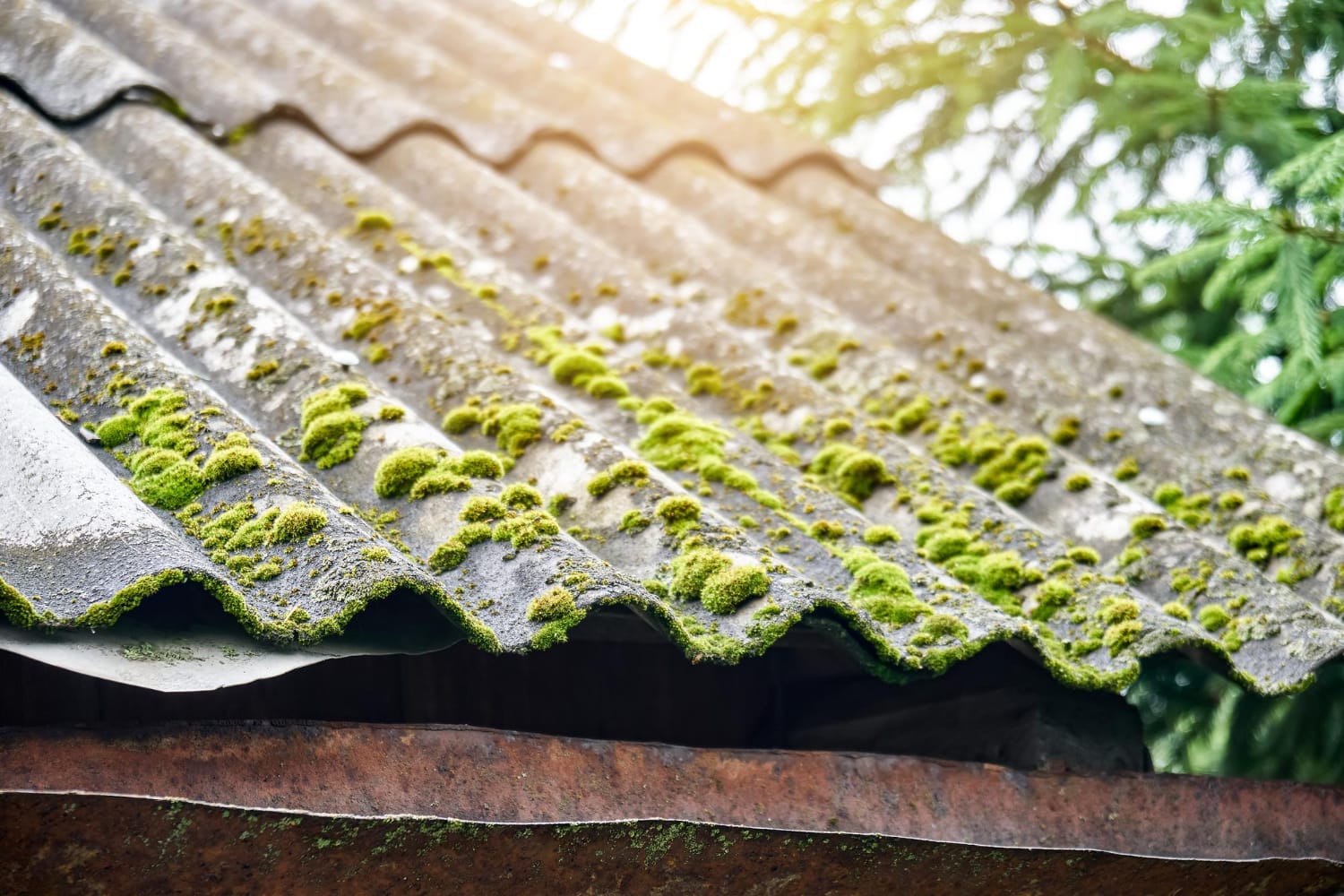
Moss and lichen do colonize north-facing slopes on shaded lots near the Patuxent River, particularly on older, rougher stone. Growth holds moisture against the slate and can accelerate weathering at the edges, but it is not the emergency some cleaning services present it as.
Is Synthetic Slate a Practical Alternative?
For most Southern Maryland homes, yes. Composite slate imitates the appearance at roughly a third of the weight, which usually eliminates structural reinforcement entirely. Most lines carry Class 4 impact and Class A fire ratings with 50-year transferable warranties.
| Factor | Natural Slate | Synthetic Slate | Architectural Asphalt |
|---|---|---|---|
| Weight per square | 800 to 1,500 pounds | Roughly 300 to 400 pounds | Roughly 250 to 400 pounds |
| Expected service life | 75 to 200-plus years | 50 years, warranty-backed | 25 to 30 years |
| Structural reinforcement | Usually required | Rarely required | Not required |
| Minimum roof slope | 4:12 | Per manufacturer, typically 4:12 | 2:12 with doubled underlayment |
| Impact resistance | Stone cracks under hard strikes | Class 4 on most lines | Class 3 or 4 on upgraded lines |
| Repair trade availability | Specialized and limited | Widely available | Widely available |
The honest caveat is time. Composite products have not existed long enough for century-scale field data, and color fading is commonly observed around 10 to 15 years while warranties cover fading for roughly 10. You are trading a proven material for a practical one, and that trade makes sense for a great many homes.
What Should You Expect From a Slate Roofing Project?
Expect a longer timeline, a smaller pool of qualified installers, and sourcing measured in weeks rather than days. Slate is a distinct trade with its own tools and techniques, and matching stone on an existing roof is often harder than setting it.
Repairs on a historic roof usually depend on salvaged slate, because the quarries that produced the original material closed decades ago. Color, thickness, and texture have to be matched from reclaimed stock. A slater working on a house in Annapolis or Leonardtown may spend more effort finding forty matching slates than installing them.
- Structural evaluation before any material decision gets made
- Sourcing and matching time measured in weeks, not days
- Copper or stainless fasteners and copper flashing throughout
- Staging and scaffolding that a shingle crew would not require
- A finished roof that will outlive everyone involved in installing it
Is Slate the Right Choice for Your Maryland Home?
Slate makes clear sense on a home that already has it and has the framing to carry it. On a house originally built for asphalt shingles, the structural work often costs more than the roof, and synthetic slate or architectural asphalt delivers a similar appearance without it.
The strongest case for slate is preservation. A house in a historic district, a home with original stone still shedding water, a property where architectural accuracy genuinely matters — those roofs deserve slate, and the repair-versus-replace question deserves a careful answer rather than a quick one.
For the majority of homes across Calvert, Anne Arundel, and St. Mary’s counties, most of them framed within the last fifty years for asphalt, slate is an aesthetic goal reachable by other means. That is not a compromise. It is matching the material to the structure.
Schedule a Free Roof Inspection in Southern Maryland
Whether you have a slate roof that needs an honest assessment or you are weighing materials for a home that never had one, the decision starts with what your structure will actually carry. G.H. Clark Contractors has served homeowners from Prince Frederick to Solomons for more than 30 years as a family-owned business answerable to the homeowner rather than to any manufacturer. Our crews will inspect the roof and the framing, tell you plainly whether you are looking at failed fasteners or failed stone, and walk you through the options that fit your home. Estimates are free and delivered without sales pressure, and financing is available.
Call G.H. Clark Contractors at (410) 414-7060 to schedule your free roof inspection.
Frequently Asked Questions About Slate Roofing
How is a single broken slate replaced?
A slater uses a ripper, a thin steel tool, to cut the nails holding the broken piece and slide it free. The replacement is set in position and secured with a slate hook or a copper nail and bib. Done properly, the repair is invisible from the ground and lasts as long as the stone around it.
What is the difference between hard slate and soft slate?
Hard slate is denser, absorbs less water, and lasts far longer. Soft slate contains more carbonate, weathers faster, and can begin flaking within 50 to 75 years. The distinction is geological rather than a matter of manufacturing, and it determines nearly everything about service life.
Can slate from an old roof be salvaged and reused?
Often, yes. Sound slate removed carefully during a tear-off is routinely reclaimed, sorted, and reused for repairs elsewhere. Salvaged stone is the primary source of matching material for historic roofs, since the original quarries closed long ago. Pieces that ring dull when tapped get set aside.
Does a slate roof need snow guards in Maryland?
Above entries, walkways, and driveways, yes. Slate is smooth enough that accumulated snow releases all at once rather than melting off gradually, and a sheet coming off a steep roof carries real force. Snow guards break the slide into manageable amounts.
Should a slate roof ever be sealed or coated?
No. Coatings trap moisture against the stone, hide the condition of the slate underneath, and make future repairs considerably harder. Any service offering to seal, paint, or coat a slate roof is proposing something that will shorten its life rather than extend it.
How can you tell whether a slate roof is nearing the end of its life?
Tap a few slates. Sound stone rings; failing stone thuds. Look for widespread flaking and delamination across the entire roof rather than isolated broken pieces, and for slates crumbling at the nail holes. Damage concentrated in one area usually points to flashing rather than age.